Greenville student wins NASA fellowship
Greenville student wins NASA Fellowship
Christine Brockman is all smiles, doing what she loves: conducting materials research as a
NASA Fellow.

Brockman’s dream was not a shot in the dark. Both her parents are engineers and
graduates of Clemson University. Her father, Robert Brockman, is a retired mechanical
engineer from BMW. Her mother is Ernestine Brockman, a computer science major, and
she works at Lockheed Martin.
When some college students are enjoying an active social life, Brockman may be busy
testing materials like ceramics not only on weekdays but also on some evenings and
weekends. Certain ceramics are less dense than metal alloys and can withstand higher
temperatures, she explains with a smile.
Brockman gets excited when she talks about the properties of ceramics, for example. Her
job is to test ceramic matrix composites to understand their high temperature mechanical
behavior, and other ceramic systems for their thermal stability and thermal expansion
properties.
Brockman draws inspiration from both her parents. Growing up, they encouraged her to
attend science and engineering summer camps, contributing to her interest in those
disciplines. She earned her Bachelor of Science degree in Materials Science & Engineering
from Georgia Tech in 2020. Shortly after beginning to work on her PhD at Oklahoma State
University in the same major, her professors urged her to apply for a fellowship at NASA.
The application process was tedious, long, and exacting, but she finished it in 2021. How
sweet it was to be awarded a 3-year fellowship with NASA which provides a student stipend
and tuition waiver.
There is double the satisfaction of knowing that you are contributing to ongoing research at
NASA, says Brockman, while learning processes that will remain useful to me during the
rest of my professional career. After graduation, she hopes to land a position in private
industry, a government lab, or a national lab. “Opportunities within national labs,” she
explains, “now include many other disciplines than before.”
It is exciting traveling to conferences and giving 15-minute presentations and fielding
questions from professors, industry leaders, and other students, she said.

“You make important connections,” she says, “when you continue seeing the same people
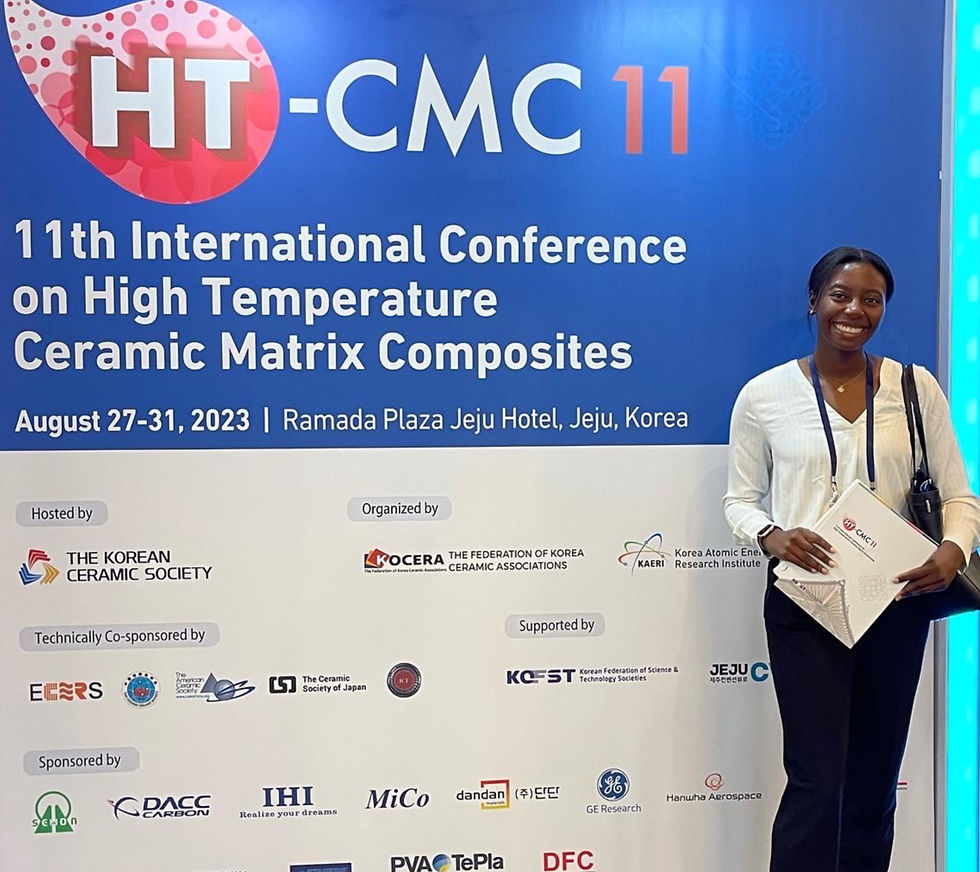
in the field.” She has spoken at several national conference meetings, and even once in
Jeju, Korea.A glow radiates from her face while she explains the details of her craft: studying ceramic
materials for turbine engine applications, while taking into consideration the effects of
temperature and other environmental conditions.
You get a sense that this is just the beginning for her. Would you welcome follow-up stories
on Brockman’s journey?


